Be yourself; Everyone else is already taken.
— Oscar Wilde.
This is the first post on my new blog. I’m just getting this new blog going, so stay tuned for more. Subscribe below to get notified when I post new updates.
In Harry M. Benshoff’s article, “The Monster and the Homosexual”, he looks at how homosexuality is often considered to be a monstrous condition. He talks about real life horrors, like the AIDS crisis, which further reinforced people viewing gays as monsters spreading death.He explains that when depicted in film, homosexuals are often lurking in the shadows, like a monster, and when they come out, they spread panic and fear in the lives of “normal” people. In the article, he explains how in film, the conflicts generally arise from what is viewed as normal confronting “the other”. Queerness often takes the role of the other in these films, and it is set up as a disruptive force that attempts to question the status quo. What is queer is almost always set up to be the opposite of the masculine society it resides in. The homosexual is looked down upon because it displays feminine characteristics and crosses all boundaries set up by the status quo.
In the film A Nightmare on Elm Street II: Freddy’s Revenge, director Jack Sholder depicts a conflict between the normal status quo, and the force of homosexuality that disrupts it. The film’s focus is on Jesse, a teenage boy who has just moved into a new town, who gets possessed by the murderous spirit of Freddy Krueger. After Jesse is forced to do terrible things by Freddy, it is up to the girl that loves him to save him from this monster.
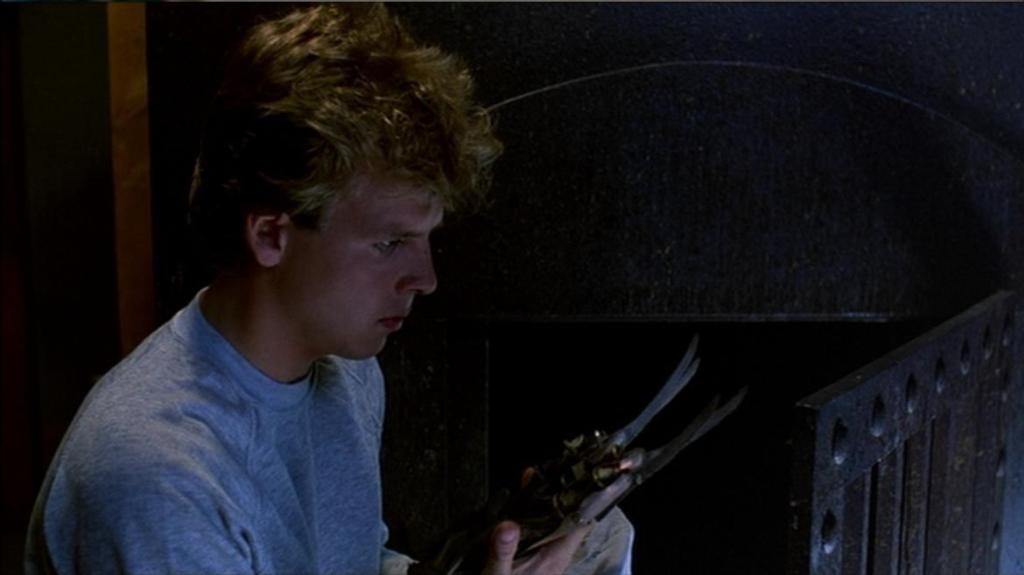
The spirit of Freddy Krueger is the disruptive force in this film that takes the normal Jesse, and transforms him into the other. When Freddy asserts his will on Jesse, it is seen as “the eruption of a queer sexual identity” (Benshoff), and it forces many repressed feelings to the surface. Jesse receives his murder glove from Krueger in the basement (Figure 1), which could represent how deep he had to go in his mind to face these repressed feelings. After he becomes bonded with Krueger, his relationship with his girlfriend and his family suffers.
The first time Jesse truly lashes out while possessed is after he is compelled to go to a gay bar, where he is caught and punished by his gym teacher. The teacher, who is clearly homosexual, is then stripped, bound, and beat in sexual manner before being killed by Jesse. The sexuality depicted in this murder shows how when Jesse acts on the repressed queer feelings, it is violent and depraved. Also, having the only openly gay character in this film get killed in this way shows the link between sex and death.
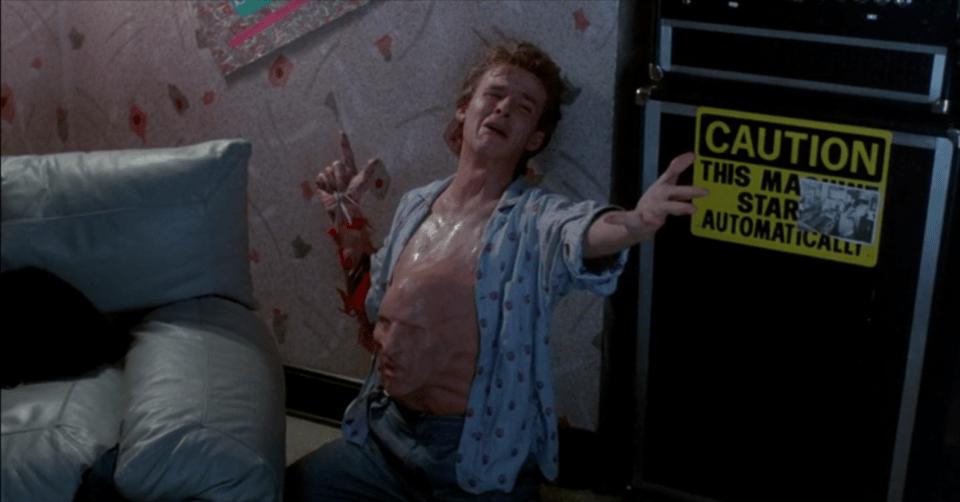
When Jesse is possessed, one character he grows closer to is Grady, who he often had to share gym class punishments with. Grady is portrayed as the hetero, masculine stereotype, which is a persona that is praised in society. Jesse, and the spirit of Freddy, end up corrupting and killing this symbol of normality, when Jesse has to stay at his house out of fear. Jesse may have believed Grady’s masculinity would save him, but in a horrifying way, Freddy emerges from Jesse (Figure 2) and kills Grady. Freddy represents “a displaced and concretized figure of phallic desire” (Benshoff), and this sexual desire had to be substituted for murder.
In Robin R. Means Coleman’s article “Studying Blacks and Horror Films”, she looks at how films in this genre reveal and portray Black cultural tropes, as well as the sociopolitical questions raised by them. She explains how horror movies raise many important issues because they deal with not only good and evil, but also social hypocrisies and inequities. She addresses two forms, “Blacks in horror” and “Black horror”, and how they are different. She says “Blacks in horror” films depict Blacks and Blackness in the context of horror, but with no goal of focusing on race. They are often mainstream productions, and they portray the racial other as a disruptive force to a fear free life. “Black horror” films convey common horror themes, but they have a major focus on racial identity, or Blackness. They are made by Black filmmakers, feature Black actors, and are meant for a Black audience. She explains how the ways Blackness is represented in these films is constantly changing and that how Hollywood and the film industry have played a major role in defining color barriers. She then depicts exactly how the image of Blackness has been defined in film by decade, from horribly violent and racist works of the early 1900s, to invisibility and inequality in the 50s and 60s, all the way to constantly being killed of first in the 80s. She closes by talking about the genre in the new millennium, explaining how it has been en-grained with hip hip culture and doomed to low-budget parodies.
In the 1992 film Candyman, many issues regarding race, social problems, and racial identity are brought to the surface. This film involves Helen, a white graduate student, as she studies urban legends and how they come to be. Her main focus becomes the story of Candyman, a mythical, Black man with a hook who appears when his name is said more than 4 times in a mirror. She becomes fascinated by the story when she learns of murders that have been committed in a poverty stricken housing project that are rumored to be the work of Candyman. As she gets more involved, the Candyman haunts her and continues to kill people close to her.
Candyman’s entire character can represent the hardships and struggles that have been placed on African Americans throughout history. His story is that of a young Black man with slave heritage that was brutally tortured and killed by white people. Candyman is portrayed as a follower, if not deity, of a “powerful savage religion” (Coleman). He calls his crimes “miracles” and the people whom he torments as his “congregation”. This power that he holds over the neighborhood is very similar to that of a in-fallible deity, and that keeps “his congregation” afraid and unwilling to change.
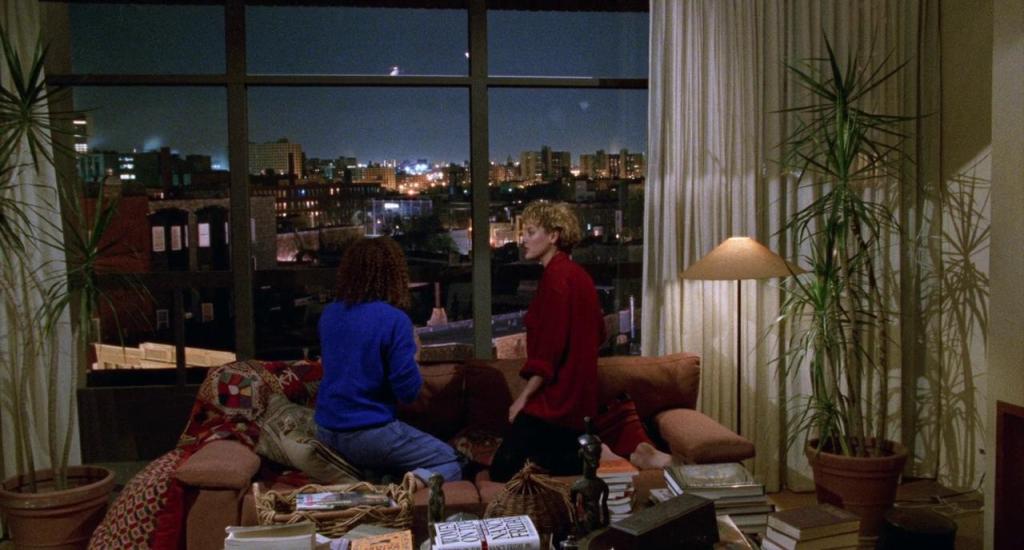
Helen’s relationship and bond with Candyman in the film says a lot about race relations and identity. From her first trip to the projects, Helen is shown to be out of place and out of touch with the people she studies, as she can safely look at the decaying city from the comfort of her condo (Figure 1). This shows the “autonomous Black subjectivity” (Coleman) in the projects, as these people have been ignored and left to fend for themselves. She represents the forces outside of the community that try to make a difference, but end up not really changing a thing. People from outside the community looking in and attempting to change it perpetuates the idea of “the racial other”, and this is the reason why it is so hard for Helen to win. While it is always her goal to help these people, in every situation, she eventually gets labeled as the bad guy, showing how hard it is to make a difference.
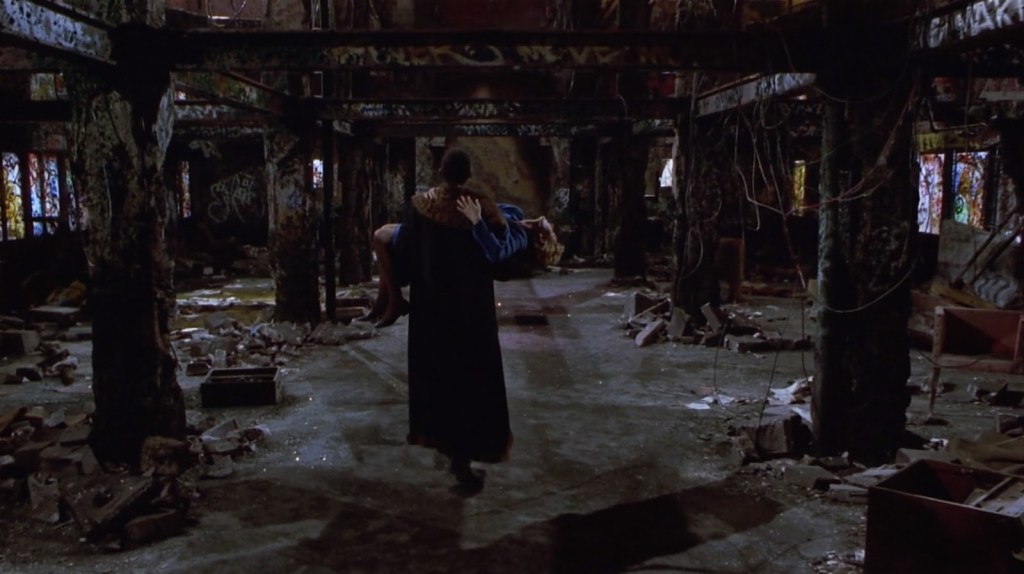
Candyman is the manifestation of all things that have plagued Black communities for years. The name Candyman itself could refer to the plague of drugs and drug dealers that take lives everyday. He also represents urban decay as his messages are written in graffiti and he makes his lair in a ruined building scattered with debris (Figure 2). It is very important that Candyman is a Black man, as it shows the harsh reality that there are people in the community that play a part in perpetuating the horror that exists for people living in it.
In Skal’s article “It’s Alive, I’m Afraid” he points out America’s fascination with freaks and monsters. He talks about how human’s are most fascinated by freaks that are products of human reproduction. Much of this has to do with sex, and this obsession reached its height when sex became a lot more relaxed and promiscuous during the 1960s, when contraceptives became common place in the country. This resulted in films that showed themes of sexual anxiety and confusion. He explains that during this period, normal childbirths in film simply did not occur anymore. Parenthood also began to be looked at differently, considering this was a period in which children constantly rebelled against their elders. Themes like fearing parenthood, loathing one’s own child, and longing to be like a child became very common in cinema.
In the 2014 film The Babadook, many issues regarding childhood and being a mother are studied. The film centers around Amelia and her son first grade son Samuel, who live alone. It is pointed out early on that the reason they are without a male presence is because Samuel’s father was killed in a car accident while driving Amelia to the hospital to give birth to Samuel. It is painfully clear that this event has driven a rift between Amelia and her son, who seems to have many behavioral issues. These problems between the young mother and son are soon blown up beyond proportion when a terrifying monster from a children’s book begins to manifest itself inside their home.
Amelia represents the stereotypical panicked mother in this film. It is clear that she has never really recovered from losing Samuel’s father, even though it has been nearly seven years. She works a miserable job at an old folks home and then she has to come home to take care of her rambunctious child. Samuel’s presence in the home is almost like “a violent invasion by the enemy” (Skal), as it is clear that she finds little comfort in his presence.
When the Babadook begins to terrorize her, it is almost a materialization of all the stress and guilt that she feels from being a mother. One of the lines in the story is that you cant get rid of the Babadook, and that idea of being trapped with no way out is basically how she feels about being Sam’s mother. Her paranoia and stress makes leads her to act on her darkest fantasies of killing her son, an action predicted by the Babadook.
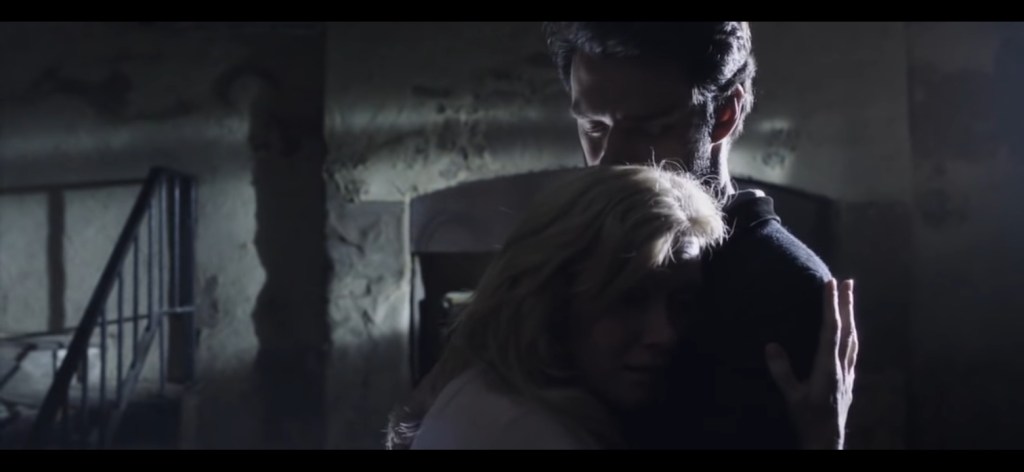
The scene that reveals a lot about Amelia is the scene in the basement where she talks to the monster, disguised as her deceased husband. He appears to her out of the shadows, as if the darkest corners of her mind suddenly materialized. She embraces him and admits that she would’ve rather had him survive than given birth to Samuel (Figure 1). This is all the audience needs to know that she resents being a mother, and this scene eventually leads to the Babadook turning her into the monster.
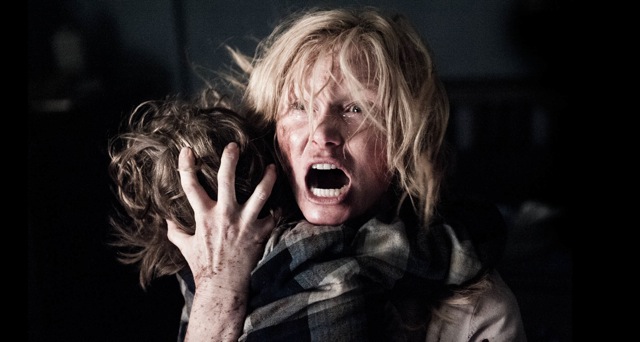
While the film ends with Amelia redeeming herself and saving her son (Figure 2), it is clear that things are not ok. The audience knows the resentment and anger that exists in Amelia is still there, and that you cant get rid of the Babadook.
In Tony Williams’s article “Trying to Survive on the Darker Side: 1980s Family Horror”, he argues that in the 1980s, horror films became more complex and contradictory. He says that while films during the genre’s renaissance in the 70s brought questions against societal norms, the films of the following decade attempted to maintain the dominant values of society. This resulted in many films that had the same structure and feel, and rewarded the masochistic society by slaughtering teens that broke the rules. He also mentions Carol Clover’s work, highlighting how gender confusion turned many of these films into battles pitting the genders against one another. He also mentions how these gender conflicts often result from a masochistic female exerting control over a male. These points all lean towards a general conclusion that conflict is incited in these films by going against the masochistic, patriarchal status quo.
In the 1987 film The Stepfather, many issues regarding family life in the Reagan era are brought to light in a devastating way. This film centers around a man who is on a bloody search for the “perfect” family, marrying single women with children and then killing them once he sees any flaws in them. This man, known as Jerry, has an obsession with tradition and the patriarchal system, and when the symbolic order is broken, he kills and starts his life over again.
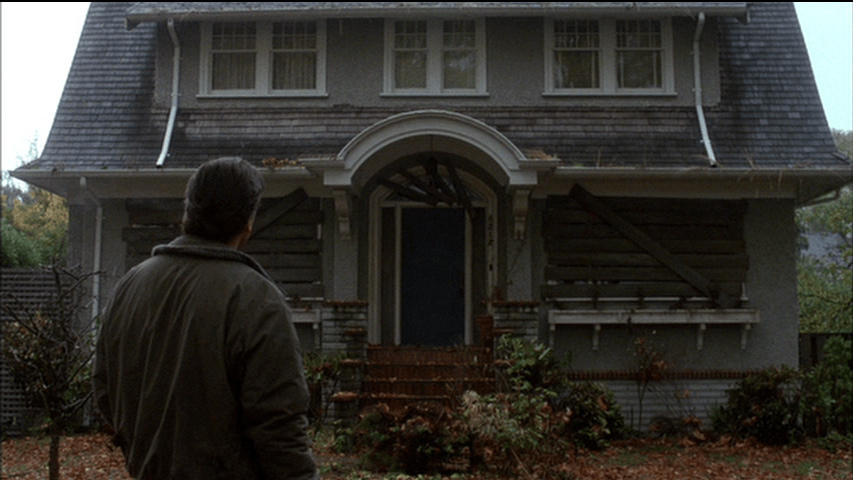
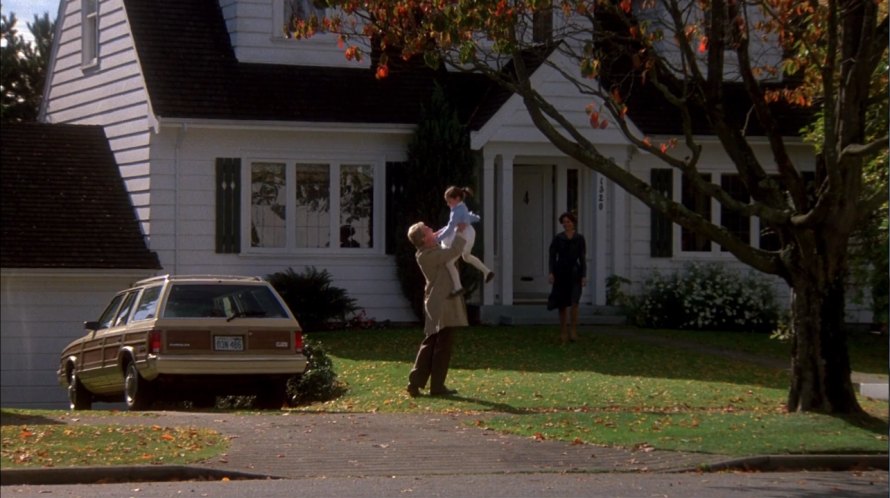
Jerry’s whole purpose is to “maintain dominant values” (Williams) that were preached to be normal in the patriarchal society of the Reagan era. He desires a big colonial in the suburbs, a wife who takes care of the house and pleases him sexually, and subservient children who get straight A’s. He works a normal real estate job, spends his free time doing handy-work in his basement, and he insists on praying before meals. The film shows he copies this mold everywhere he goes, as the two houses the audience sees in the film are eerily similar in almost every way (figure 1).
Stephanie, Jerry’s adopted daughter, represents everything Jerry resents. Jerry terrifyingly wants his relationship with Stephanie to resemble “a master-slave power relationship, stemming from within the patriarchal family”, in which she follows his will without question. However, this proves not to be the case as Stephanie gets expelled, snoops into his past, and kisses a boy on Jerry’s own doorstep.
Jerry is troubled by Stephanie because the one thing he craves above anything else is complete control over his life and the people in it. He adheres to the “Law of the Father” which “aims at preventing the emergence of alternative personal structures”, and maintaining his personal power. He views everything that undermines his control as a threat, including the idea of Stephanie seeing a therapist, which he sees as another man influencing her thoughts. Before he kills the therapist, Jerry briefly mentions his strict home-life as child and this could answer why he needs so much power over others, especially if he had a dominating mother.
Jerry has devoted his life to controlling others and that has elevated himself above everyone in his own mind. He never once believes that he is in the wrong, after all, his values are backed by the status quo. This rejection of personal wrongdoing can be seen after Susan berates him for yelling at Stephanie after she was caught with a boy. When she admonishes him, he snaps and begins to prepare to kill them. This urge to kill them was also confirmed after he spies on another family happily embracing (Figure 2). He believes the perfect family is out there, he just does not see that he can never be part of one.
In the 1974 film The Texas Chainsaw Massacre, director Tobe Hopper presents a twisted version of rural America. Many scholars view this film as apocalyptic, meaning that the events of this film were unprovoked and unpreventable, and it could only end in death. While this film has a very apocalyptic feel, Tony Williams believes that there are “veiled material forces” that manifest themselves in the carnage that unfolds.
The main reason why films of an apocalyptic nature exploded in popularity during the 70s and 80s was because many old American institutions and values, that were deemed to be just and unbreakable during the postwar period, began to unravel. This gave birth to a new outbreak of nihilism, also known as post-modernism, which was brought to the screen through horror films. The Texas Chainsaw Massacre feels apocalyptic because in the film, 5 young adults are stranded in a somewhat otherworldly part of Texas and are picked off one by one for what seems like no apparent reason.
Williams believes that there are many reasons behind the events that take place in this film. He describes Leatherface and the slaughterhouse family as “losers within the American ideology”, who very much correspond with the Puritan feelings towards the savages on the outskirts of society. They are basically the embodiment of the “other”, and they are meant to represent everything American society views as abject.
The contrast between the family and status quo society is made painfully clear by the scene in which they pick up the Hitchhiker (Figure 1). Franklin immediately labels him as “other” by saying “I reckon we just picked up Dracula”. The Hitchhiker carries an animal pelt bag, has long unkept hair, and a red streak across his face, made to symbolize his similarity to the savages of american folklore (Figure 2). Williams says that the hitchhiker “appears in answer to Franklin’s gory fantasies”, which hints that society created this monster just to hate it.
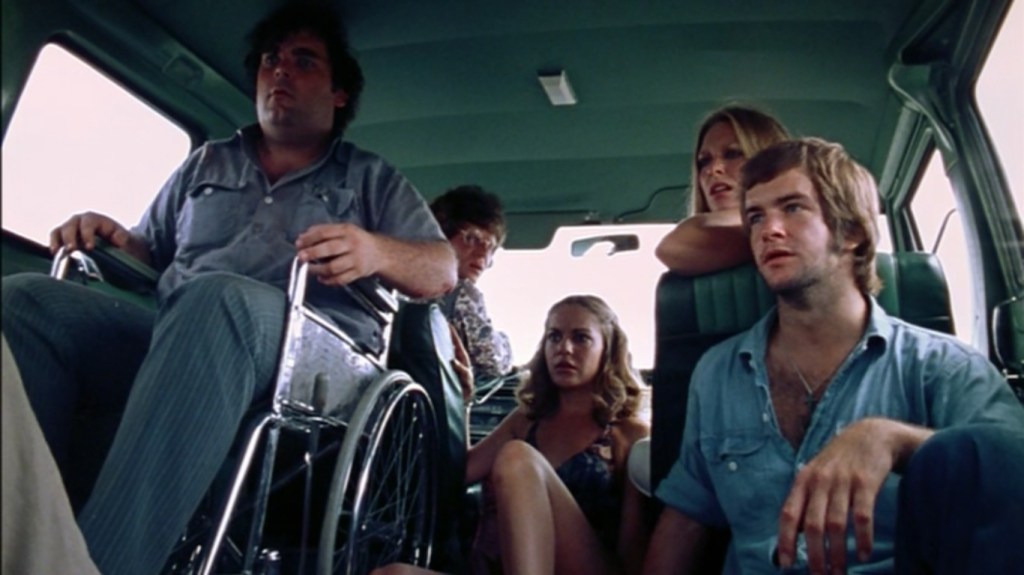

Williams tries to make clear that while the practices of the family are horrid, they are a result of society, not just evil to the core. It is clear that they have been rendered useless by advancing technology, and their abandonment in the wilderness has forced them to repress their violent tendencies. They succumb to these tendencies when their opposites, white teenagers who come from the society that shunned them, arrive. As Leatherface carves through these kids like the meat he used to work with, his purpose is to “take revenge on those who have made him obsolete”.
Tony Williams, in his article “Chainsaw Massacres: The Apocalyptic Dimension”, argues that while films like The Texas Chainsaw Massacre are seemingly apocalyptic, they actually have wider social issues at play. He talks about how the christian, capitalist American society has shunned all those on the outskirts, basically turning them into repressed savages, and this is very much the case for the slaughterhouse family. Their existence has been made obsolete by new technology and they are forced to kill to survive. The victims in the film represent those who have prospered in this society, and their vanity, laziness, and ignorance allows for them to be easily hunted. Williams shows how the slaughterhouse family inverts all traditional values held sacred by society, and propagates only violence and destruction.
When one watches Brian De Palma’s 1976 film Carrie, one could easily come to the conclusion that it is a revenge film. After all, the film’s most triumphant moment is when Carrie White lashes out at the people that have constantly berated her. While Carrie’s actions in the film are very much based on rebelling against her fundamentalist mother and the school community that mistreated her, this is not the only way to look at this film. In her article “Horror, Femininity, and Carrie’s Monstrous Puberty”, Shelly Stamp argues that this is not a revenge film, but a film that shows the horrors of female adolescence and sexuality from a masculine perspective.
As soon as this film starts, the audience is immediately made a voyeur in the massively important opening scene, which is set in a female locker room. The camera rolls through the rows of lockers showing females both exposed and unexposed, before finally focusing on Carrie, alone in the showers. At this moment, the audience sees Carrie at bliss, but this tranquil moment is interrupted in a shocking way as she menstruates for the first time (Figure 1). Any sort of peace and tranquility is then completely stripped as the girls crowd around her, screaming “Plug it up!”, instantly portraying the onset of female puberty as ugly and a subject of shame. Stamp says that this scene intends to portray that “female sexuality announces itself with a particular violence”.
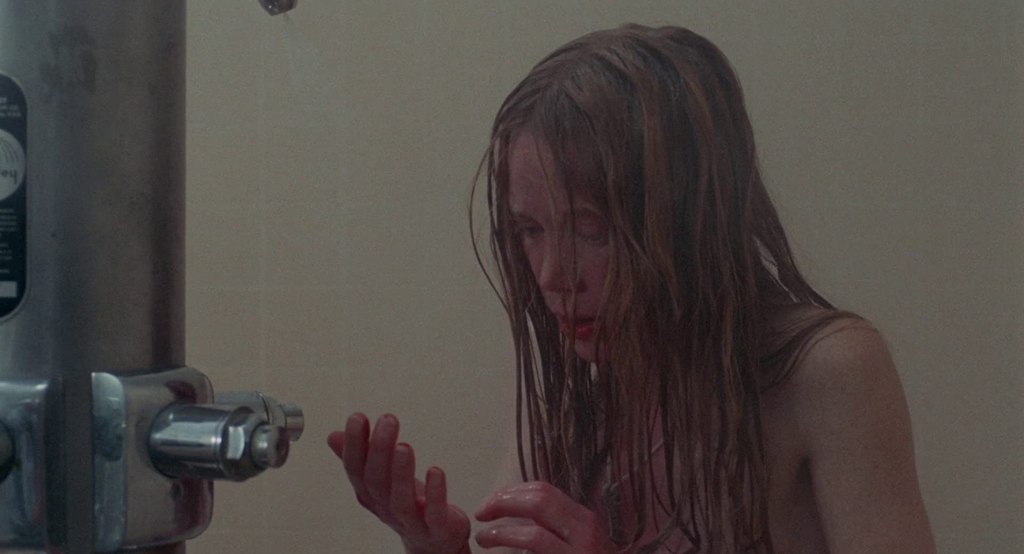
After this traumatic experience, Carrie is presented with two different ways of dealing with her new-found femininity by the two prominent women in her life: her fundamentalist Christian mother, and her gym teacher, Miss Collins. Mrs. White views her daughter’s burgeoning sexuality as a “transgression” and she forces Carrie to either repress all sexual tendencies, or suffer corporal punishment. Miss Collins is the opposite as the film portrays her as sympathetic to Carrie. She presents Carrie with a “liberating view of femininity”, that is achieved through “good posture, lip gloss, and curls”.
While these viewpoints seem to be direct opposites, they both tie into one of the main themes of the film, which is the masquerade. Both Mrs. White’s idea of sexual repression and Miss Collins’s view of confidence through things like makeup and pretty clothes attempt to cover up the true horrors of female sexuality. While Miss Collins’s work with Carrie can be seen on the surface as helpful to her, all it is doing is “stressing her body’s external surface, or her image”, while what she really is deep down gets covered up.
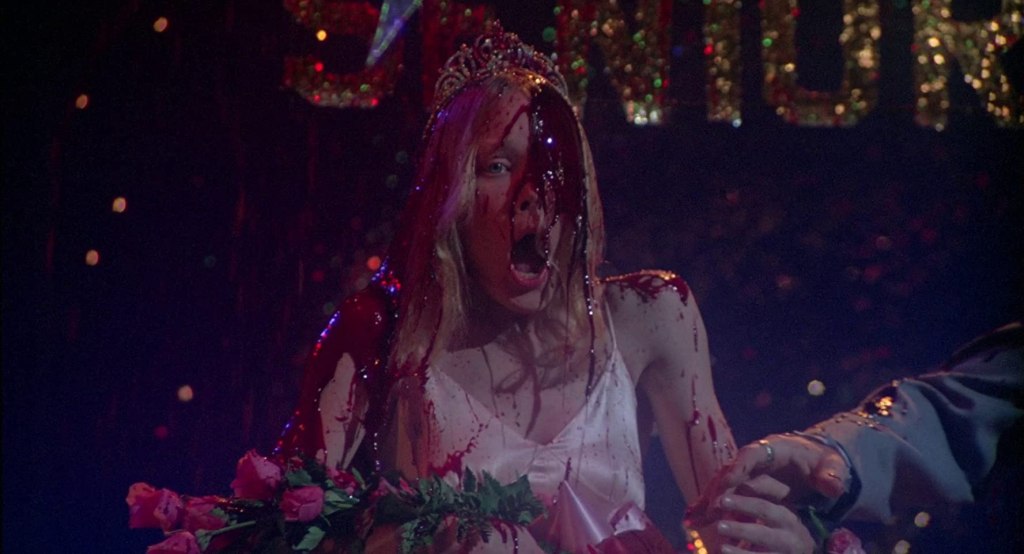
This film is very much goes full circle in a story that begins with Carrie’s first sexual awakening in the shower, and ends on prom night. When Carrie goes to prom, she fully wears the mask presented to her by Miss Collins. She wears a beautiful dress, lip gloss, curled hair, and at her side is Tommy Ross, the boy which all of her sexual desires are linked to. When she is at the prom, this mask stays on and “for a brief instant, Carrie seems to have recaptured the moment of ecstasy witnessed in the shower”, but that is ruined when Chris dumps a bucket of pigs blood on her head. This moment unveils her, taking away her comforting exterior, and revealing the true feminine monster (Figure 2). The horror that ensues, with Carrie using her telekenetic power to destroy everyone in the gym, is supposed to represent the true danger of unchecked femininity.
In the 1973 film The Exorcist, director William Friedkin uses the horror genre to explore what society views as despicable. In her article “Horror and the Monstrous-Feminine: An Imaginary Abjection”, Barbara Creed classifies these things under the word abject. Creed cites the abject as “that which does not respect borders, positions, rules, and that which disturbs identity, system, and order”, and the expulsion of this horror is the abjection. In this film, Friedkin presents the abject as a demon which inhabits the mind and body of a pre-teen girl and forces her to do horrific things, and the film revolves around abjection, or trying to remove the horrific from her. The actions of Regan expose how society feels about the monstrous feminine and other things that are abject.
Of the different forms of the abject that are present in this film, the most obvious is the paranormal force that possesses Regan MacNeil. This entity which overtakes her is from a foreign land and attacks Regan in America, showing how this force is abject because it does not respect the boundaries created by society. Creed also says “the place of the abject is the place where meaning collapses”, and this is very much evident in the film as everyone from Regan’s mother to an army of doctors haven’t the faintest idea of what is doing this to her. This shows that when society deems something un-explainable, it is labeled as the other.
When Regan gets possessed, she goes from a normal 12 year old girl to a foul-mouthed monster. As Regan struggles with the demon, she goes through a drastic physical change and she begins to resemble a corpse (Figure 1). The transformation from living to corpse is listed by Creed as the ultimate abjection because a corpse is “a body without a soul”, and death is the ultimate, universal fear. More abjections come in in the form of bodily wastes like blood, urine, and vomit, which have the intention of pulling the viewer over their own mental boundaries.

Regan becoming possessed triggered serious physical and emotional changes for her, showing that this demon can be seen as a metaphor for female puberty. When a girl has her first period, dramatic physical changes and hormonal outbursts are sure to follow, and these things are often portrayed very negatively by society. It is almost as if this girl has had her innocence replaced by a monstrous femininity that seeks to castrate, and in this case, kill.
This is made most clear by the change in the relationship of Regan and her mother. At their introduction, they are seen as very loving and caring for each other, but that all changes when Regan is possessed (Figure 2). This represents how mothers are often viewed as abject by their children as they go through puberty. Creed cites that as a child attempts the abjection of the mother, “the child struggles to break free but the mother is reluctant to release it”. As Regan is possessed, her mother keeps on insisting that this monster is not her daughter, showing how mothers often struggle with accepting the maturity of their children. This also shows the overall struggle of humanity in dealing with what society considers to be abject.

When one looks at the climax in popularity of the teen slasher film, Wes Craven’s 1996 film Scream is just that. This film is an unapologetic homage to the genre as it clearly stays true to the formula that all slasher films of the 70s-90s followed. This is very much a meta-film because it is almost like the characters know that they are part of a slasher film and are guided by the slasher formula.
All slasher films must have an interesting killer and that is certainly the case for Scream. The killers in this film, Billy and Stuart, are two high school boys obsessed with and motivated to kill by horror films like Halloween and Nightmare on Elm Street. Billy, especially, fits the persona of the slasher villain because he is clearly sexually disturbed, partially because his girlfriend, Sidney, won’t have sex with him and that humiliates him.
These killers utilize shock tactics, like appearing out of no where, and also use a knife for the majority of the killings, making the murders more gore-y and brutal. Carol Clover in her article “Her Body, Himself” explains why slasher films are so bloody by saying “the slasher evinces a fascination with flesh or meat itself as that which is hidden from view.” This is utilized in this film as characters often have to see the dismembered corpses of their friends or loved ones, giving them and the audience a good shock (Figure 1 and Figure 2).


The way in which people are killed off in this film is varied by gender, and that is a major cliche of the slasher film. When men are killed, it is because “they make mistakes” (Clover), and are often discarded quickly. When Steve, Randy, and Dewey are attacked, the audience doesn’t see it happen, just the aftermath. Females in this film get it far worse as the sexual frustration of the killers is released as they are killed. When women die in this film, the audience sees their terror and pain up close and personal. Carol Clover said when filming female victims in slasher films, the main focuses are “tits and a scream”, as these females are usually overly sexualized. This is very true with Tatum, as throughout the film she is portrayed as very sexually confident, and for this, she is murdered in an extremely violent fashion.
Sidney, this film’s version of the final girl, is the main focus of the film. Sidney is a contrast to Tatum as she is not focused on sex, which is a trait associated with the final girl. This idea is played with in the film as Randy says that in order to survive a horror movie, “you gotta be a virgin”. When Sidney decides to have sex with Billy towards the end, the audience is meant to be troubled because of this idea that “sexual transgressors are scheduled for destruction” (Clover). However, Sidney is able to outlast the killers and in more instances than one, she is shown to be both smarter, and stronger than either of the killers.
When one thinks of the slasher film, John Carpenter’s Halloween is one of the first films that comes to mind. This is because the 1978 film was one of the first to utilize all of the elements that turned the slasher genre into one of the most iconic genres of all time. Carol Clover, in her article Her Body, Himself, presents five components that are essential to this style of film: 1.) the killer, 2.) the terrible place, 3.) the weapons, 4.) the victims, and 5.) shock effects. Halloween’s version of this film formula was not only one of the first, but it also popularized this formula.
The iconic killer presented in Halloween is Michael Myers, a man who brutally murdered his sister as a six year old and now hunts again after being in an asylum for 15 years. Clover describes the slasher film killer as an outsider who is “propelled by psychosexual fury” as well as “in the grip of boyhood”. Michael is portrayed from the beginning of the film as a ruthless boogeyman who is described by his physician, Dr. Loomis, as being void of feeling and full of evil. His actions are clearly sexually driven as he brutally slaughters his sister after a rendezvous on Halloween with a boy, and later in the film, he kills Bob and Lynda after they had just finished having sex. Michael kills his victims in an extremely personal way, using weapons like knives, rope and his hands, which show that murder is his substitute for sex. Michael’s first murder occurred when he was six years old, and he seems to be forever trapped in that mindset. He steals the grave of his sister and later ritualized Annie’s body as if to recreate the first crime (Figure 1), showing how Michael is forever living in that childhood moment.
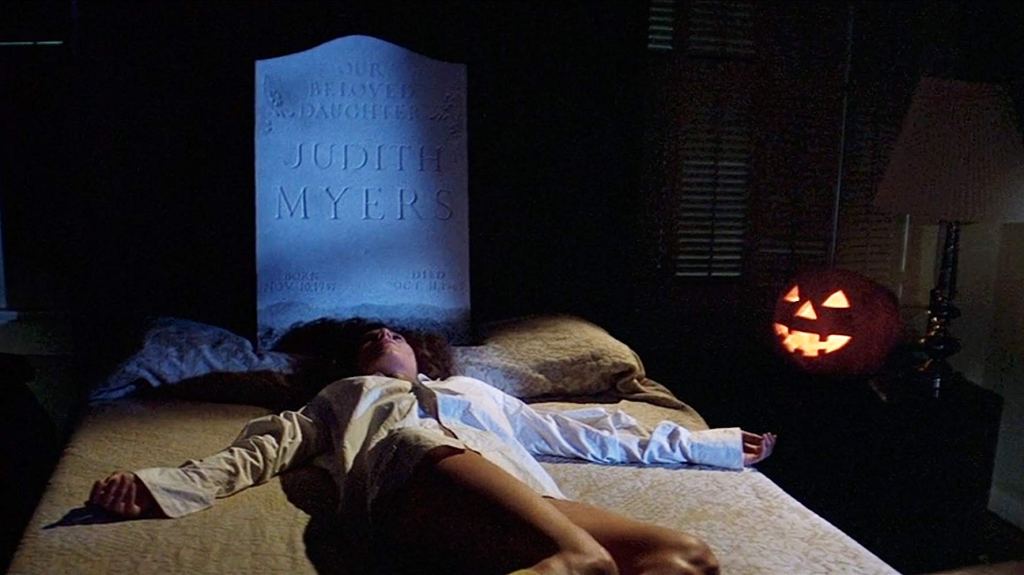
This film makes wide use of shock effects, as there are constant jump scares and shots that emphasize surprising the audience. Michael often pops out of the shadows, as shown in figure 2, making it so he is subjected to only the audience’s gaze and not the victim’s. This makes the audience feel the fear of the characters in the film as the audience becomes untrustworthy of every closet and dark corner.
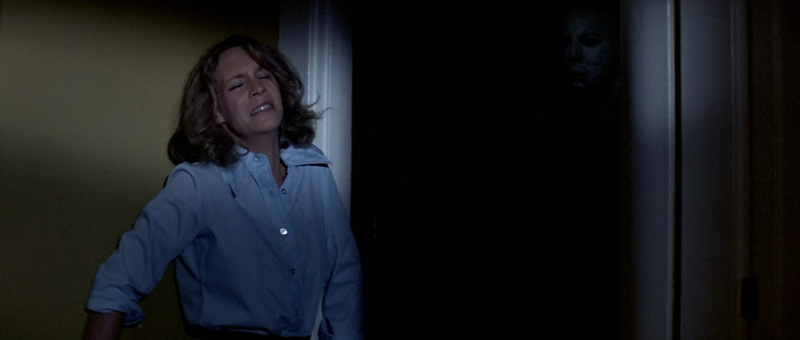
The Myers house is this film’s version of the terrible place, and it fits the genre perfectly. This house was clearly once a beautiful, historic home, but it has been forever linked to the horrible crime that occurred there. Much like the house, which can’t escape the link to Michael, the victims also can never escape, which includes Laurie, as Michael survived to perhaps return to enact his vengeance.
The cast of victims, cut down one by one by the killer, are crucial to every slasher film. Following the formula, the victims in this film are teens, and this film also holds true to the fact that in a slasher film, “those who seek or engage in unauthorized sex” (Clover) don’t last long. Annie is killed as she leaves the Doyle house to hook up with her boyfriend, and Bob and Lynda are soon killed off after having sex in the “empty” house.
The most important victim is always the final girl, represented in this film by Laurie. Clover describes the final girl in the slasher genre as “abject terror personified”, and this is true with Laurie as she sees the dead bodies of her friends and understands that she is next to die. The audience sees her perspective as she is trapped in the closet, helplessly waiting for Michael to slash through the door and kill her. Even though she realizes her terrible situation, the final girl is the only victim that actually is determined enough to make a stand against the killer. Laurie is able to escape Myers long enough for help to arrive, and in doing so, she turns into the film’s hero.
In his 1960 classic, Psycho, Alfred Hitchcock redefined the idea of a horror film. Not only did Hitchcock introduce a monster who is terrifyingly human in Norman Bates, he drastically changed the role that women and femininity can play in this genre. As said by Linda Williams this “marked a significant break in the structure of the classic horror film, inaugurating a new form of psychological horror. ” Hitchcock’s approach to this film would become integral to the post-modern horror genre.
In classic monster films that were popular in the decades prior to Psycho, female characters often looked towards the monsters with sympathy. Williams said that this look “recognizes their similar status in patriarchal structures”, and this compels these women towards these monsters. In these films, when the female looks at the monster, she is punished for it.
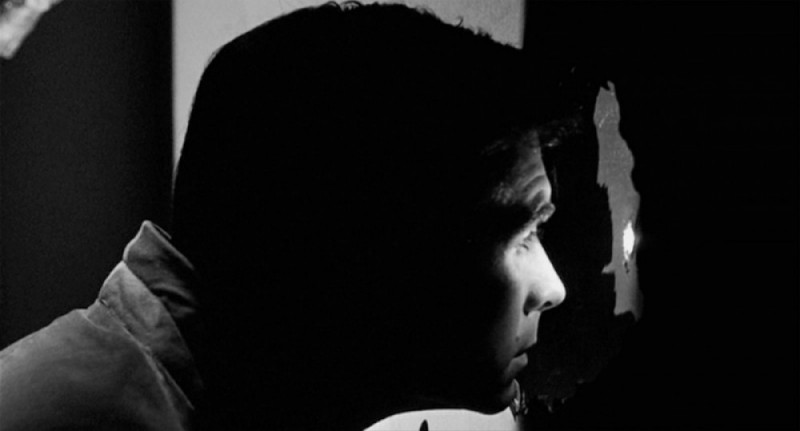
In Psycho, it is not what the woman does that gets her punished, it is what feelings she evokes. This is clearly shown in the death of Marion Crane near the beginning of the film. When Norman Bates spies on Marion through a peephole (figure 1), he sees her getting undressed. Seeing her in this way and the emotions that result from this force Norman to brutally kill her, perhaps to suppress his scopophilic desire for her. As Laura Williams puts it, Norman is “threatened by her sexuality”, and it was not her gaze that got her punished, it was simply her femininity. In this scene, she is “isolated, on display, and sexualized” (Mulvey), and Norman controls his urges by killing her.
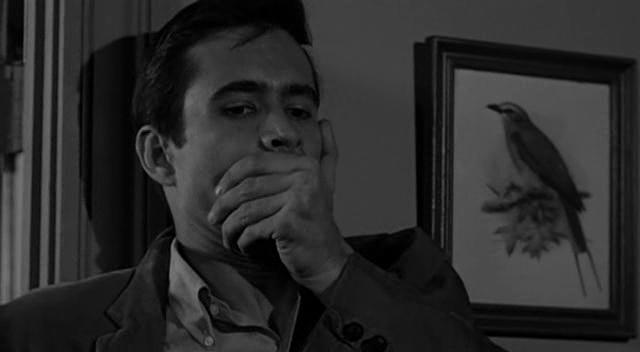
In this film, femininity, not Norman Bates, is the real monster. At the end of the film, it is revealed that Norman has a split personality, himself and his mother. This dual-persona resulted from him murdering her after years of abuse, and his guilt forcing him to keep her alive in his mind. It becomes clear that his mother side is the controlling and truly wicked part of him. Throughout his life, Norman was mentally castrated by his mother, and that forced him to become a monster. Hitchcock makes it clear that it is “the woman in this man that kills” (Williams), as he dresses up like his mother when he goes to commit these vile acts. When he returns to clean up the scene as Norman, Figure 2 shows that he is overwhelmed by the sight of what “his mother” has done, suggesting that the male side of him is capable of feeling guilt.
In the end, Hitchcock presents a structure for the psychopathic killers of post-modern horror. Norman, who’s deceased mother constantly castrates him in his own head, sees Marion Crane in a voyeuristic way. His “fetishistic scopophilia” (Mulvey) stimulates his male desires, which then forces the mother side of him to act to control these urges. This killer, who is driven to kill by the urge to control female sexuality, would lead to a complete redefinition of the horror film monster.
Have a WordPress.com account? Log in now.

