When one thinks of the slasher film, John Carpenter’s Halloween is one of the first films that comes to mind. This is because the 1978 film was one of the first to utilize all of the elements that turned the slasher genre into one of the most iconic genres of all time. Carol Clover, in her article Her Body, Himself, presents five components that are essential to this style of film: 1.) the killer, 2.) the terrible place, 3.) the weapons, 4.) the victims, and 5.) shock effects. Halloween’s version of this film formula was not only one of the first, but it also popularized this formula.
The iconic killer presented in Halloween is Michael Myers, a man who brutally murdered his sister as a six year old and now hunts again after being in an asylum for 15 years. Clover describes the slasher film killer as an outsider who is “propelled by psychosexual fury” as well as “in the grip of boyhood”. Michael is portrayed from the beginning of the film as a ruthless boogeyman who is described by his physician, Dr. Loomis, as being void of feeling and full of evil. His actions are clearly sexually driven as he brutally slaughters his sister after a rendezvous on Halloween with a boy, and later in the film, he kills Bob and Lynda after they had just finished having sex. Michael kills his victims in an extremely personal way, using weapons like knives, rope and his hands, which show that murder is his substitute for sex. Michael’s first murder occurred when he was six years old, and he seems to be forever trapped in that mindset. He steals the grave of his sister and later ritualized Annie’s body as if to recreate the first crime (Figure 1), showing how Michael is forever living in that childhood moment.
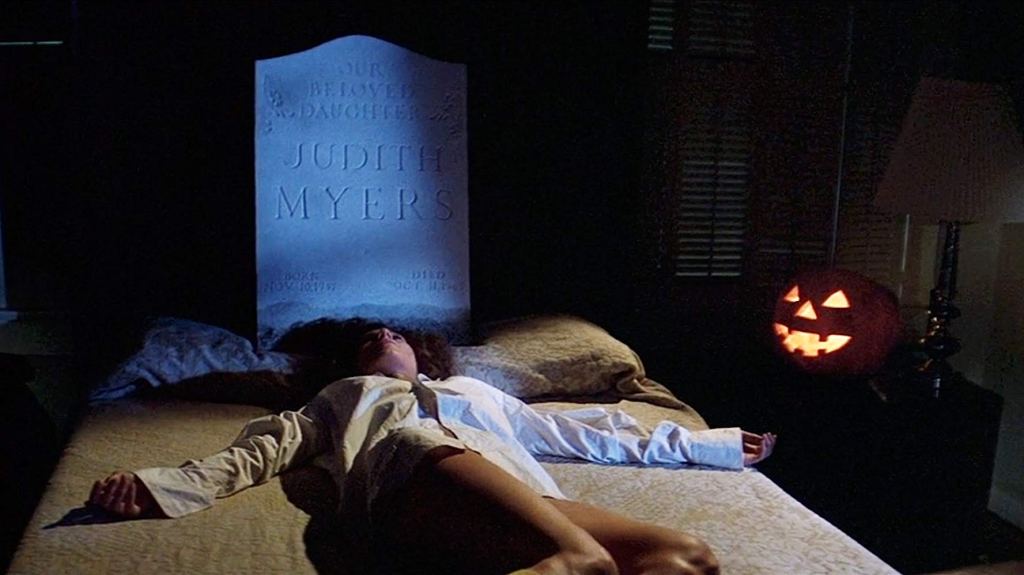
Compass International Pictures
This film makes wide use of shock effects, as there are constant jump scares and shots that emphasize surprising the audience. Michael often pops out of the shadows, as shown in figure 2, making it so he is subjected to only the audience’s gaze and not the victim’s. This makes the audience feel the fear of the characters in the film as the audience becomes untrustworthy of every closet and dark corner.
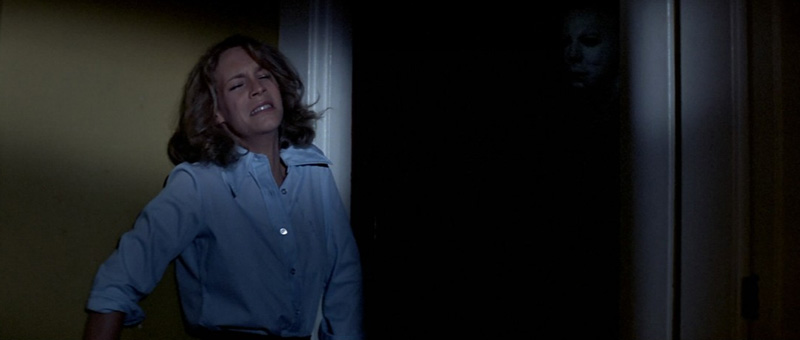
Compass International Pictures
The Myers house is this film’s version of the terrible place, and it fits the genre perfectly. This house was clearly once a beautiful, historic home, but it has been forever linked to the horrible crime that occurred there. Much like the house, which can’t escape the link to Michael, the victims also can never escape, which includes Laurie, as Michael survived to perhaps return to enact his vengeance.
The cast of victims, cut down one by one by the killer, are crucial to every slasher film. Following the formula, the victims in this film are teens, and this film also holds true to the fact that in a slasher film, “those who seek or engage in unauthorized sex” (Clover) don’t last long. Annie is killed as she leaves the Doyle house to hook up with her boyfriend, and Bob and Lynda are soon killed off after having sex in the “empty” house.
The most important victim is always the final girl, represented in this film by Laurie. Clover describes the final girl in the slasher genre as “abject terror personified”, and this is true with Laurie as she sees the dead bodies of her friends and understands that she is next to die. The audience sees her perspective as she is trapped in the closet, helplessly waiting for Michael to slash through the door and kill her. Even though she realizes her terrible situation, the final girl is the only victim that actually is determined enough to make a stand against the killer. Laurie is able to escape Myers long enough for help to arrive, and in doing so, she turns into the film’s hero.
 Site Title