In his 1960 classic, Psycho, Alfred Hitchcock redefined the idea of a horror film. Not only did Hitchcock introduce a monster who is terrifyingly human in Norman Bates, he drastically changed the role that women and femininity can play in this genre. As said by Linda Williams this “marked a significant break in the structure of the classic horror film, inaugurating a new form of psychological horror. ” Hitchcock’s approach to this film would become integral to the post-modern horror genre.
In classic monster films that were popular in the decades prior to Psycho, female characters often looked towards the monsters with sympathy. Williams said that this look “recognizes their similar status in patriarchal structures”, and this compels these women towards these monsters. In these films, when the female looks at the monster, she is punished for it.
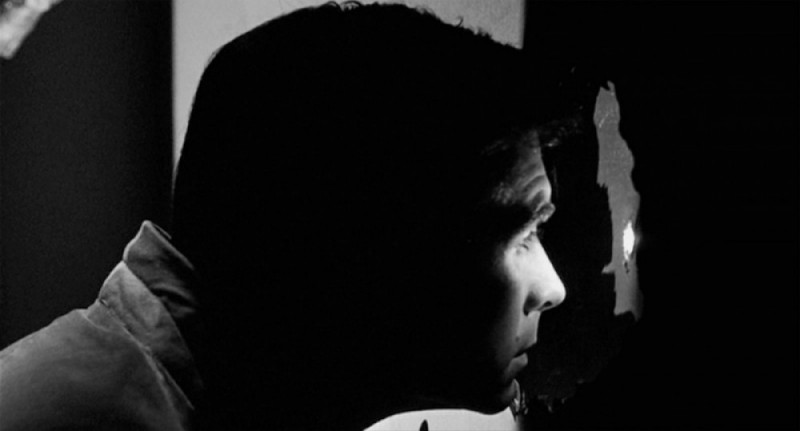
In Psycho, it is not what the woman does that gets her punished, it is what feelings she evokes. This is clearly shown in the death of Marion Crane near the beginning of the film. When Norman Bates spies on Marion through a peephole (figure 1), he sees her getting undressed. Seeing her in this way and the emotions that result from this force Norman to brutally kill her, perhaps to suppress his scopophilic desire for her. As Laura Williams puts it, Norman is “threatened by her sexuality”, and it was not her gaze that got her punished, it was simply her femininity. In this scene, she is “isolated, on display, and sexualized” (Mulvey), and Norman controls his urges by killing her.
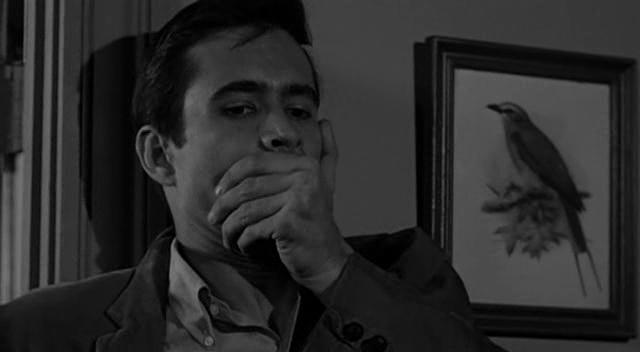
In this film, femininity, not Norman Bates, is the real monster. At the end of the film, it is revealed that Norman has a split personality, himself and his mother. This dual-persona resulted from him murdering her after years of abuse, and his guilt forcing him to keep her alive in his mind. It becomes clear that his mother side is the controlling and truly wicked part of him. Throughout his life, Norman was mentally castrated by his mother, and that forced him to become a monster. Hitchcock makes it clear that it is “the woman in this man that kills” (Williams), as he dresses up like his mother when he goes to commit these vile acts. When he returns to clean up the scene as Norman, Figure 2 shows that he is overwhelmed by the sight of what “his mother” has done, suggesting that the male side of him is capable of feeling guilt.
In the end, Hitchcock presents a structure for the psychopathic killers of post-modern horror. Norman, who’s deceased mother constantly castrates him in his own head, sees Marion Crane in a voyeuristic way. His “fetishistic scopophilia” (Mulvey) stimulates his male desires, which then forces the mother side of him to act to control these urges. This killer, who is driven to kill by the urge to control female sexuality, would lead to a complete redefinition of the horror film monster.
Universal Pictures
Universal Pictures
 Site Title