When one thinks of the post World War II suburban lifestyle, one often pictures perfect family harmony. However, director Bryan Forbes in his 1976 film The Stepford Wives paints a completely different picture of this period. With this film, Forbes shows that suburban housewives, the life they were forced to conform to was far more horrific than how it had been advertised. This perception of the housewife of this era builds upon what was said in Betty Friedan’s “The Feminine Mystique”, which revealed to the world how far from perfect this way of life was.
In The Stepford Wives, the main protagonist, Johanna, moves with her husband and two children away from New York City to the quiet, affluent suburb of Stepford. She immediately is taken aback by the way that all of the wives in the town seem to do nothing more than housework to please their husbands. This kind of behavior in women was far to common in this period as most were taught that “their role was to seek fulfillment as wives and mothers” (Friedan). While Johanna is presented as a good mother and wife, it is clear that she wants something more.
As we see Johanna’s discontent grow, the audience also begins to see a controlling and manipulative patriarchy that seems to have sway over the entire town. As Johanna navigates the intrigue of the town, she begins to become a threat to this patriarchy as Christopher Sharrett puts it, she is a “potentially liberated woman”. This patriarchy is directly represented in the film by the men’s club, which is an organization that consists of Johanna’s husband and all of the other prominent men in the town. Throughout the film they do many shady things like closed door meetings, drawing sketches of all the wives, and even recording their voices. It is never clear what their plans are… until its too late.
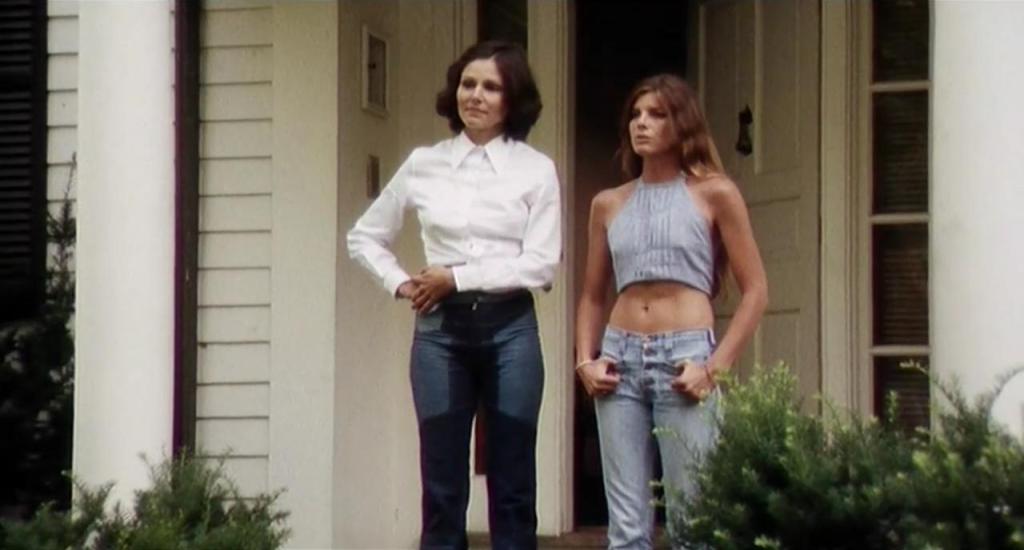
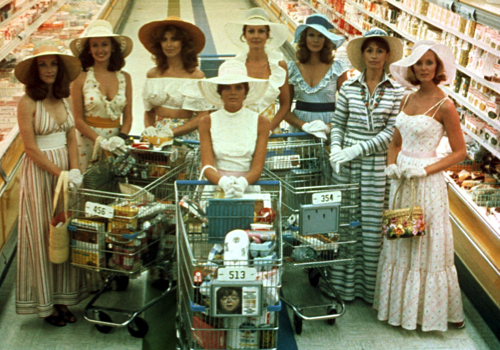
The film reaches its peak when Johanna realizes what these men are doing, replacing the women they married with identical robots that are manicured to be perfect. This is symbolic of the image of the perfect wife that was drawn during this period. This was the image of a woman who was “healthy, beautiful, educated, concerned only about her husband, her children, and her home” (Friedan). In this transformation women lost anything that made them individual or unique. In the film, this shift can be seen in the clothing the women wear. Figure 1 shows Johanna and her friend Bobbie before the “transformation” wearing jeans and loose-fitting clothes, and also hairstyles that symbolize their freedom and individuality. Figure 2 shows them after the transformation, wearing basically identical sundresses, hats, and hairstyles, symbolizing what their husbands want them to be.
This film shows that even though the life of a housewife seems to be ideal on the outside, the reality of the situation is that it is quite a hopeless life. Even though Johanna knew the severity of her situation for a large part of the film, there was nothing she could do about it.
Source: Paramount Pictures
Source: Paramount Pictures
 Site Title